Monday, July 30, 2012

Free Picture Prompts for Fall Writing


Hello, Everybody!

Are you busy preparing your literacy centers for fall?

I think one of my favorite centers to organize at back-to-school time is the Writing Center. I love to stock the center with lots of interesting tools for writing - cool wiggly eye pens, a can of freshly sharpened pencils (none of those scrunchy little ones with toothmarks and no eraser!), a rainbow of colored pencils, and a big bunch of colorful markers that still work!

I also make up a bunch of blank books for writing, in all sizes and shapes. Stapling together 4-8 pieces of blank paper is all it takes to inspire some of our young authors to get serious about making books. 

I like to have a box of interesting things to write about, like acorns and colorful leaves (warning: beware of the bugs!! Sadly, this is the voice of experience speaking. Yuck.)  Sometimes I'll cut out giant leaves for the children to write on, or have cardboard leaf tracers in the center. Trace a leaf and use it to write a shape poem around!

I love having topical picture/ word cards as references for writing ... mini-dictionaries for our kiddos!

Here are 2 more easy additions to your Writing Center as you get set up for the change of seasons - picture prompts for writing! One uses a graphic organizer to get ideas rolling for writing about Johnny Appleseed. The other is about choosing between 2 favorite fall activities, and justifying the choice.

These prompt pages would also be great to display with your document camera for whole class writing activities. They'd be a great no-prep plan for a sub, too!

Click on the cover to download yours from Google Docs.


These free picture prompts are samples from this set of 16 back to school and autumn prompts. Click here to see it at my TpT store.


Please leave a comment to share one of your favorite tools to put in your Writing Center!

Happy Teaching!


Freebie Fridays

Friday, July 27, 2012

Back-to-School Picture Prompt Freebie

Hello, Everybody!

Don't you just love it when you can kill two birds with one stone in your teaching? I mean, honestly, if you don't teach cross-curriculum -ly  (sorry - just can't get this sentence to behave the way I want it to!), how can you possibly get to all of those objectives?  I love to incorporate cross-curricular teaching into my resources!

This set of three picture prompts for writing does just that.


1.  It allows for some class bonding time when you have some sharing time after writing, as part of your beginning of the schoolyear getting-to-know-you activities. The foundation for good conversations and for your character ed curriculum!

2.  Because the writing is done independently, this resource gives you the opportunity to get a finger on the pulse of your students' writing: Are they enthused about writing or reluctant? Quick finishers? Detail oriented? How's the organization of the piece? Sentence structure? Mechanics? Ideas? Voice?  You get the idea, I'm sure. Without doing a formal assessment (although you could of course develop a rubric and use it that way), using these prompts will give you a feel for your students' strengths and their needs.

3. It's free!! Never a bad thing, right? :)  Enjoy!


Download them now at my Teachers Pay Teachers or Teachers Notebook stores.


Freebie Fridays

Happy Teaching!


Tuesday, July 24, 2012

Making Mistakes... It's a Good Thing

I'm a firm believer that every student comes to us with strengths. Those strengths just won't be as evident in some students as others, but that doesn't mean for a minute that they don't have them.

Here's a way to get some early informal literacy assessment in with your kindergarten through second grade students and discover those strengths early.

I like to start the school year with the walls basically empty in my classroom. There's a new calendar on the wall, bare and ready to begin on the first day. None of the calendar wall components are up until they are introduced, usually one or two each day. The alphabet headers are up for the word wall.
That's it. Usually, I don't even tape the students' name tags to their desks, cubbies, or coat hooks. We do that together, so I can watch them find their names and/or respond to questions about their names, like "Whose name starts with R?", "Whose name starts with the same sound as banana?", "Who has a name with 2 claps (syllables)?", etc.

We use shared writing to make many of the reference charts on the classroom wall. Sharing the pen
definitely takes longer than doing it yourself, but the value of that time is immense.

Here's an example of a little piece of shared writing we created together during the first week of school.


My struggling first graders often came to me unwilling to take risks, because they had so often been wrong in the past. If  kids aren't willing to take risks in their reading and writing, their progress is often stalled. They have to be encouraged to take a step out and try something that they've not yet mastered, knowing that it's okay to make mistakes because that's part of learning.  I spent a fair amount of time making intentional mistakes of my own, to help build their confidence in the fact that mistakes are common and totally forgiveable! In fact, "It's okay - everybody makes an 'oops"!" became one of our class slogans.

After reading  Oops! Made a Mistake, by Kirsten Hall,  we talked about the fact that everyone makes mistakes. This led to the little learning opportunity you see in the picture above.


Usually, we'd work on white paper, so we could make an "oops!" disappear through the magic of white tape, the very forgiving first grade version of white-out. Actually, working on yellow turned out to be great this time, so we could "display" the errors and make nothing of them!


This mini-chart was made with the whole class, but let's pretend that you observed as just one student wrote it independently. (We'll assume that you'd be helping on some of the tougher words.) What strengths do you see in this student's writing?

Here's a starter list:
The student began at the top of the paper.
The student wrote from left to right.
The student was able to write some sight words independently. ( a, is, to)
The student used return sweep on multiple lines of text.
The student used appopriate spacing between the letters in words.
The student used appropriate spacing between the words in the sentence.
The student heard and recorded first sounds/letters in several words.
The student started the sentence with a capital letter.
The student used the appropriate ending punctuation.
The student formed many letters correctly.

Weaknesses? Well, formation of the letter c would be pretty much it.

This piece of writing, and the abilities of the writer, show many more strengths than might first meet the eye, don't they?

Of course, we know that what we see in this writing may only be tentative control rather than mastery, and will need reinforcement. In spite of that, it's evident that this student has already learned many, many things!

Just think about what you'd learn about this child's literacy by having him read his writing back to you!

This may not be something you have time to do with all of your students. But if you can, take a few minutes with each of your strugglers and try it. It will guide your instruction, but will also guide your attitude in seeing that each and every one of your students has strengths. Focusing on what they can do, and celebrating their achievements, will help you keep your instruction at the cutting edge of each child's learning.

Do you see other strengths in this writing?

Long but heartfelt post. Thanks for sticking with me.
Happy Teaching!


Monday, July 23, 2012

Using Keys for Your Learning Centers

Hi, Everyone!

Isn't it nice to spice up your learning centers once in a while with something really novel and high interest? The little learners just can't wait to get their hands on them!

Did you know that you can get mismade keys for free at home improvement centers and hardware stores? Talk about a novelty item for your classroom!

It's easy to mark the keys with dimensional paint (AKA puff paint), nail polish, or permanent markers. If your key doesn't have a smooth surface, put on a little paper tag or sticker, and seal it with a layer of ModPodge  for durability.


Here are photos of a few simple-to-prepare ways to use keys in your centers.


Since the photos are not that great, I've put it all together into the google doc that you can download by clicking on the cover photo at the top. There's a list of ideas,  and also the mat that you see in the photos.

Please leave a comment with your ideas for using keys!
Happy Teaching!


Sunday, July 22, 2012

Free 120 Chart Game

Hello, Everybody!

As the Common Core standards have moved our kindergarteners and first graders up to counting to 120 instead of 100, I thought I'd share this simple little 120 chart game with you. Students will count dice dots and move ahead the appropriate number of spaces. The "twist" in this game is landing on a star or sticker, for moving ahead an additional one space (+1)  or 10 spaces (+10). Common Core standards are included on the cover.


Click here to download your copy!


Happy Teaching!


Friday, July 20, 2012

Class Books... on the playground!

Hello, Teaching Friends!

A playground break is awesome for the first days of school, when we're struggling to get everyone back into gear, including ourselves! I always have hopes of making those playground trips happen more often during the year, but time usually squeezes it out of my plans... until the last days of school, when it again becomes a lovely (and sometimes desperately needed!) treat.

Here's a way to combine a trip to the playground with your literacy instruction. Take your camera along to capture some clear photos of your students in action.

During the first weeks of school, use those pictures as the basis for some shared writing. It's easy to incorporate verbs like "run", "jump" and "slide" when there's so much happening in your pictures. Depending on the level of your students, have them independently attempt a caption (hey, there's a non-fiction Common Core standard in it when you use that word "caption"!), share the pen for some interactive writing, or do some modeled writing as your students dictate.


Sorry that I don't have any photos of the delightful "kid writing" that resulted when we shared the pen. We displayed the finished photos as a wall story - supply a cute pointer and you have a great opportunity for reading the room!

After a few weeks , the pictures came down and were bound into a class book. This is a fun and simple project that yields lots of ongoing practice with the rereading of the class book. All young readers love to see themselves in a book!

Here are a few ways to change it up a bit but still keep a literacy focus to your playground photos for the end of the year.

-  Have your students add speech bubbles of the characters (aka classmates) in conversation as
   they play.

-  Use the photos as a basis for a shared reading book for next year's class.  Your current students
    write, you type it up, glue on the captions, and bind it. Now it's ready for you to use during the
    first week of school, and a good springboard for discussion about playground behavior.Guide this
    year's group of writers into including some repetitive language in their writing, and next year's
    students will benefit even more!

-  Make multiple copies and have each student plan, write, and edit a creative story based on the
   picture of his or her own choice. This is a great project for writing buddies, whether for the 
   students in your own class, or partnering with an older or younger child.

-  For younger students, generate a shared list on chart paper, writing some of the words you might
   use to label the photos (climb, swing, girl, clouds, dirt, etc.)  Give each child a copy of the photo
   of his choice, have him choose the words he needs for labeling it, copy them on self-stick labels
   or sticky notes, and put them on the photo.

Do you have some other ideas for using playground photos? It would be wonderful if you'd share
them  below!

Hmmm... I'm thinking hard to come up with a playground-themed freebie that you might enjoy... aha!
Here's a differentiated making words set. At the first level, the target word "playground" is supplied.
Challenge your more advanced students with the second level, in which the students must discover on their own the word that uses all of the letters.


Happy Teaching!


Tuesday, July 17, 2012

Free Money for Classroom Pets

Hi, Teaching Friends!
This post contains affiliate links.

Do you have a classroom pet?


Get ready for a silly story that could only happen in the primary grades.

We weren't allowed to have classroom pets. "Allergies" was the reason give.  Hmmmm. Do you know anyone who's allergic to lizards? How about goldfish?

Well, anyway, after we'd read those much-loved Fluffy the Guinea Pig books by Kate McMullan, a little cage would mysteriously appear in our classroom one morning. The children would go over to investigate and - lo and behold, buried in the wood shavings and with his own little food dish - there was Fluffy! So, okay, he was a stuffed animal, but pretending is okay, and pretend we did! You should have seen the faces on adult visitors as the Pet Person (yep, Fluffy rated a caretaker!) would take their hand and guide them to the cage to see our guinea pig, cautioning them to be quiet because "Our Fluffy is kind of shy"! So.much.fun!  Fluffy also became the subject of much writing in our classroom, as well as the motivation for lots of non-fiction reading. We even wrote and solved number stories about Fluffy!


Like I said, only in the primary grades. And with a kinda nutty teacher, :)

I'm thinking that many of you are fortunate to be able to have REAL pets, so here's something I ran across that I'll bet you'll be excited about!

Did you know that the Pet Care Trust offers teachers grants for classroom pets? The grant program is due to reopen on August 1st, so click on the icon below to go find out more. The site is also a great source of information and suggestions for your pets and their care.

7/18: I just heard from a teacher who's had a very successful experience with this program. Read about it at . http://sciencegal-sciencegal.blogspot.com/2012/01/pets-in-classroom.html . Thanks for sharing, Leslie!
Happy Teaching!


Monday, July 16, 2012

Writing Folder Freebie

Hi, Friends!
How often during Writing Workshop have you been part of this scenario?


Student: I want to write about my cousin Michele, but I don't know how to write her name.

Teacher (after the usual "What do you hear first?", "What else can you hear?", etc): Here you go...  M-I-C-H-E-L-E.'

Student (looks at paper): No, that's not it.

Teacher (adds another 'l')

Student: No, that's not it, either.


Between multiple spellings and uniquely beautiful names, that scene sure did play out frequently in my classroom. So I made up the little form that I'm sharing with you today to help out the little writers... and their teachers, too!

Two sizes are included, so you have the option of a full page in a binder or a half page attached to the pocket of a portfolio folder.

I gave this to parents to complete at Back to School Night. Of course, you'll want to stress "clear printing" to the adults, so this will really become a useful tool. The kids were always thrilled to see the names of their own special people and pets, and the chart often became the source of new ideas for writing, too.


I hope you'll find it useful, too!


Click to download your copy!


 Happy Teaching!


Sunday, July 15, 2012

Number Words and Color Words - Freebie!

When I first started teaching, we always taught number words and color words early on. Then, for a brief interval, I started to question why. How important was it to devote time and attention to these words? Why not focus on high frequency words and let kids just "pick them up" as we developed and taught from classroom reference charts?

Well, I rethought all that. (If you're a regular follower of this blog, you know I do a lot of rethinking... I prefer to think of it as learning and growing, instead of just stagnating! :)

First of all, color words and number words are prominently featured in written directions, whether you use worksheets, centers, or both. Why not give a bit of attention to teaching the words, to help our students become more independent?

Secondly, these words are an early opportunity to teach "looking beyond the first letter", and "check it with your finger. Does it look right?", both of which are important early reading behaviors.

Here is a free set of number word/color word make and trace cards. Your students will trace the words with wipe-off markers and use the correct color clay to fill in the circles. Tracing, rolling, smooshing, smashing ... all good stuff for small motor development!

I'd suggest printing your cards on cardstock and double laminating, since this kind of activity usually means a lot of wear-and-tear on the cards.

Click here to download your free make and trace cards!


These cards are a sample from Number Words and Color Words Sorting and Matching Activities, just posted at my TpT store.  I'd love it if you'd take a closer look - just click on the picture!


http://www.teacherspayteachers.com/Product/Number-Words-Color-Words-Sorting-and-Matching-Activities-278954


Got to go - streaks in the sky and big boomers!! Here comes another thunderstorm ... lately it's been our daily conclusion to another hot and humid day.

Happy Teaching!


Thursday, July 12, 2012

It's More than ABC...

Hello, Everybody!

Don't you love the look of pride on a child's face when she proudly announces that she knows the whole alphabet and sings the "ABC Song" to you ..."elemenopee" and all? It's a huge step on the road to literacy!

As teachers, we know that there's a lot more to knowing the alphabet than just singing the song! There are so many ways to "know" the alphabet! 

Here's a way to share that information with parents. It's set up as a checklist, so it might even be put up on someone's fridge as a handy reminder of learning yet to be accomplished. This would be a nice hand-out for Open House, Meet the Teacher, or parent-teacher conferences. Click here or on the picture below to go to google docs for your free copy.


The guide for parents is part of "I Can't Believe I Know the Whole Alphabet", a new product at my TPT store. It's a collection of alphabet resources for PreK and kindergarten teachers, and includes 47 pages of cards, charts, puzzles, sequencing mats, and games.


Click here or on the pictures to see it!


Happy Teaching!


Tuesday, July 10, 2012

One Free Game for Practicing Prepositions ... and lots more FREEBIES!

Hi, Friends!

Just a short post today to deliver a new freebie to you! It's another Four-in-a-Row game, this time for prepositions. Your first graders can play it by just reading the words, and for second graders, maybe you'll want them to read them and use in a sentence. Click to get your copy!


Bet you're wondering about the "lots more freebies"...

Did you know that you can have easy access to lots of my free items anytime clicking the"Freebies" button right under the header  at the top of this page?  There are 15  23 items there now, and of course I'll be adding more as time goes by. Also, there are 29 FREE ITEMS at my TPT store. Hint, hint: might be a good idea to become a follower at both places, since not all of my freebies at TPT make it over here to my blog, and vice versa.

What can I say? I like to share! :)


Happy Teaching!


Monday, July 9, 2012

Come Along & Visit... I'm Guest Blogging!

Hi, Everybody!

I'm so excited to be doing my very first guest blogging ever! Come along to Pocket Full of Kinders, where Shuna has graciously allowed me to man the keyboard for a post about using ASL finger spelling as a tool in your classroom. Think...

             Quieter Classroom
       Students who think before they raise their hand

Interested? Click here...


Thanks, Shuna!

Happy Teaching!


Sunday, July 8, 2012

Free T-Shirt Class Book

Don't you just love making class books?  No books in your classroom library will ever be as popular with your students as the ones they've worked on together to write and illustrate. (well, at least until they fall in love with Mo Willems' books ...)

Starting to build a collection of class books right from the first week of school has several advantages.

* You're getting an early start on building a classroom community. Your students will get to know one another and you will learn more about them, too, from their likes and dislikes to their handwriting and spelling strengths and needs!

* As your students contribute to a whole class project, they will see that you give equal value and importance to each of their contributions, bolstering the confidence of the less secure little ones.

* Class books can help you quickly build a collection of books that will be readable for every student in your class.

* Reading class books is a great way to introduce buddy reading procedures. Because the text will be very familiar to both of the readers, neither will feel at a disadvantage, and your teaching focus can shift to appropriate student behaviors for buddy reading.

The earliest class books can be built on common experiences, such as responses to a read-aloud:
" I see a ____________  ______________ looking at me" is a favorite we've probably all done.
How about the experiences your students bring from ouside the classroom? Families, homes, and personal favorites are all the basis for many class book ideas.

There are a number of ways to bind your class projects into books. I used to think that laminating every page was kind of wasteful. but I changed my mind.  These books will get lots of use and need to last all year! Once laminated, one of the most durable ways to bind is with a binder (like a GBC) and plastic combs. Pages can also be holepunched and then secured with looseleaf rings, chicken rings, or even with string or pipecleaners. Another idea is to use portfolio folders, widely available at ridiculously low prices for back to school. Cut the cover page to size and tape on the front, holepunch
each student page, and simply put them in the folder as if you were assembling a report.

After you've assembled a large enough collection, you may want to start sending books home with a different child each night to read to their families. I staple a page inside the back cover for  parents to write a short comment. The kids all get to bask in the praise! :)

Here's a free book to help you get started on your first class book project.


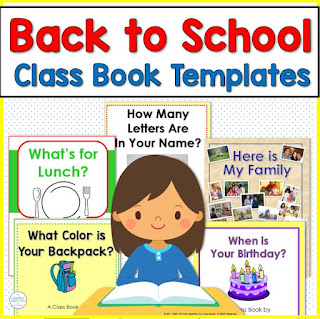
If you're looking for more books for your class to make together, I hope that you'll consider this collection of five back to school class books at my TPT store. Each book includes a cover, student template (printable in color ot grayscale), and a related data collection activity.


Happy Teaching!


Saturday, July 7, 2012

A Garden DIY and a Go-Along Math Freebie


Hello, Everybody!

I'm going to be teaching a few craft sessions at a local retreat center starting this week, so I'm spending some time today getting some sample projects made. Then it occured to me that since this seems to be DIY Summer on the teaching blogs, maybe this is a project that you'd like to try for your classroom.


Decoupage is a really easy way to make a personalized container for holding classroom items, like pens and pencils, note cards, wipe-off markers, or any of a hundred things that would much rather scatter themselves around the classroom than be conveniently located in one spot! I love gardening, so choosing a motif was a snap for me. Think about what you enjoy, and make this container something that will give you a smile each time you look at it!


Supplies:

Terracotta flowerpot (a variety of sizes at garden centers & craft stores)
Packets of flower seeds (cute old-fashioned ones are currently 4/$1 at dollar stores. It took about 4-5 to cover a 5" pot.)
Scissors (fancy ones are great, but plain would do the job, too)
Decoupage medium (I've always used ModPodge, but am currently experimenting with the cheapo Pinterest substitute... a half-and-half blend of white glue and water. So far, so good!)
Foam pad brush

1. Choose your seed packets.


2. Cut off the front panel. Cut the picture into several pieces (mostly flat-edged shapes). I like to use some of the words, too, keeping them whole. Save your little scraps for covering gaps later.


3. Use a foam pad brush to apply the decoupage medium to the back of each piece. Overlap them as you press them onto the flowerpot. Tip some and rotate others. Cover any gaps with those little scraps you saved.


4. When the pot is covered, put a coat of your MP or glue over it all. Done!

Variations:

Cover only the rim.
Cover the whole pot.

How cute would this be for an end-of-year parent gift?

Soooo, thinking about flowers got me thinking about what I can give you as a freebie today. I got out my new toy, AKA a Bamboo tablet! Now, I like to draw and was really excited about the potential of using the Bamboo in products, but the eye-hand coordination on this thing makes me feel like a five-year-old with a new Etch-a-Sketch. There 's a learning curve, as they say.

So when you download today's freebie, have mercy on me, please. In the meantime, while I'm practicing, have fun with Crazy Daisy Bump (2 addends). Click here or on the picture.


Happy Teaching!


Related Posts Plugin for WordPress, Blogger...